BUYER GUIDES
White-Light vs ICG Fluorescence Endoscopy: A Buyer’s Guide to Scope Families
Understand white-light and ICG/NIR imaging modes, compare Opentic’s current rigid endoscope families, and prepare the system details needed for a scope-matching discussion.
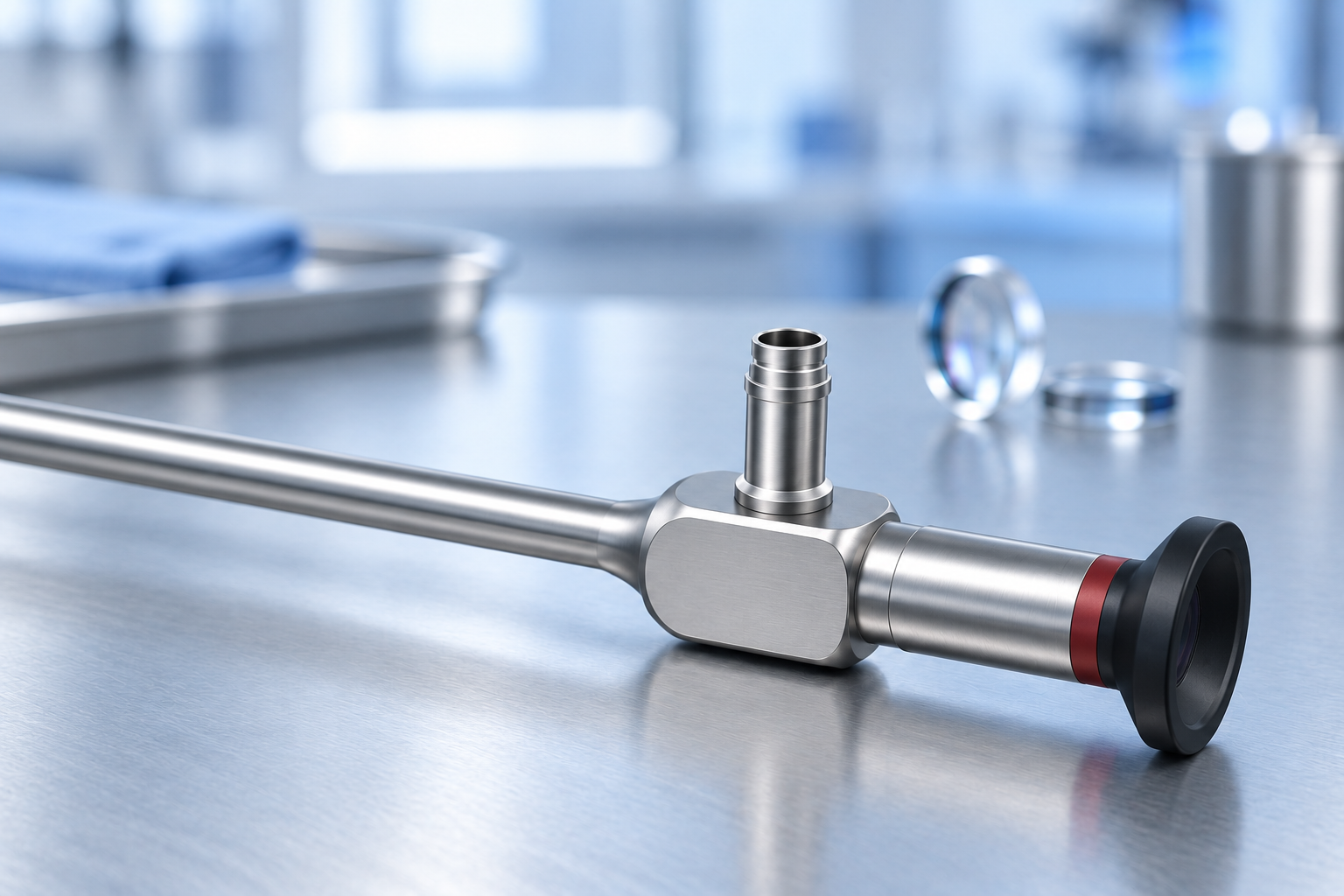
A buyer asking for an “ICG endoscope” may mean a rigid optical scope, a camera system or an entire imaging tower. Those are different supply requests. Before comparing products, establish which component is needed and which imaging modes the complete system must support.
For distributors and system manufacturers, the useful starting point is two decisions: the scope family being discussed, and the white-light or visible/NIR configuration to be evaluated. This guide explains those decisions without turning a product category into a promise of compatibility or clinical suitability.
White light and fluorescence answer different imaging questions
White-light imaging provides the familiar visible view of anatomy: surface appearance, colour and structural detail. It is the visual context against which instruments and surrounding anatomy are viewed. The displayed result still depends on the scope, illumination, camera and processing; the phrase “white light” is not a performance specification.
ICG fluorescence imaging adds information from a fluorescent signal detected in the near-infrared, or NIR, range. The system converts that signal into a view the operator can see. It does not replace the information in the white-light image. For example, a manufacturer’s overlay mode can combine a white-light view with fluorescence information, while another display mode presents the fluorescence signal separately. Those are display choices within a particular system, not features that should be assumed for every scope. 1
The buyer’s question is therefore not simply “Which mode is better?” It is “Which modes are required, and which complete configuration supports them?” A request for ICG capability should identify the imaging chain rather than rely on the word fluorescence in a product name.
| White-Light | ICG / NIR | |
|---|---|---|
| Primary information | Visible anatomy, colour and surface detail | Additional fluorescence information |
| Scope requirement | White-light optical configuration | Visible + NIR capable scope |
| Additional system needs | Standard visible imaging chain | Appropriate illumination, spectral separation and NIR-capable detection |
| Replaces white light? | — | No — it adds another information layer |
A fluorescence-capable scope is one part of the system
For purchasing discussions, keep five parts of the imaging chain visible:
- Scope: the rigid optical component and its intended imaging modes.
- Illumination: the source and light delivery appropriate to the proposed configuration.
- Spectral separation and filters: the arrangement that separates the fluorescence signal from illumination.
- Camera and detector: the hardware intended to capture the relevant signal.
- Processing and display: the operating mode that presents the acquired information.
These functions need not be five separate boxes. The components and the location of filtering depend on the platform. The filter principle is to select relevant light and reject unwanted light; it does not prescribe one universal endoscope layout. 2 A manufacturer’s NIR system listing illustrates why a scope, camera, source and light cable must be considered together. It is an example of that manufacturer’s system, not evidence of compatibility with Opentic. 3
A mechanical connection alone is not enough to establish a suitable visible/NIR combination. Likewise, a 4K camera label does not establish NIR capability. When upgrading an existing tower, identify what remains in place and what changes before discussing a replacement scope.
For the deeper engineering explanation, see ICG Fluorescence Imaging in Minimally Invasive Surgery. That article discusses spectral transmission, detection and focus behaviour; the purpose here is to help a buyer define the initial request.
How the four Opentic product families are organized
The current product portfolio combines two scope families with two imaging categories. These are Opentic product configurations, not universal size requirements for procedures. Current family pages provide the model tables. 4
White-Light Laparoscope
The White-Light Laparoscope family has a 10 mm insertion diameter and is intended for white-light imaging. Start with this family when the request concerns a rigid laparoscope for a white-light configuration; confirm the exact model and system pairing separately.
ICG Fluorescence Laparoscope
The ICG Fluorescence Laparoscope family has a 10 mm insertion diameter and is designed for visible and NIR imaging. It is not a “fluorescence-only” product category. Its fluorescence use depends on a suitable complete imaging system.
White-Light Thoracoscope
The White-Light Thoracoscope family has a 5.4 mm insertion diameter and is intended for white-light imaging. This identifies the current product family; it does not establish suitability for every thoracic procedure or access arrangement.
ICG Fluorescence Thoracoscope
The ICG Fluorescence Thoracoscope family has a 5.4 mm insertion diameter and is designed for visible and NIR imaging. A buyer should name the proposed camera and illumination platform rather than assume that an existing fluorescence system accepts any NIR-labelled scope.
Across these current families, 30° is the primary configuration presented, with 0° also available. Direction of view is a separate specification from field of view. The angle choice does not determine whether a complete system supports fluorescence. Check the model table for working length and other published configuration details rather than choosing from a family name alone.
What to send before a system-matching discussion
An initial request becomes easier to evaluate when it contains a short configuration record:
- Required family and mode: laparoscope or thoracoscope; white light only or visible/NIR imaging; component supply or a wider integration discussion.
- Existing platform: camera head, processor and software mode, illumination source, light cable and any relevant filtering. Use model identifiers, not only brand names or “4K”.
- Connection details: coupler and mechanical interfaces, including the parts that will remain unchanged.
- Scope configuration: insertion diameter, working length and direction of view required for the proposed product discussion.
- Evaluation context: what combination will be assessed, which documentation is needed and the intended market. Clinical suitability and applicable labeling require their own review.
For example, “We are comparing a visible/NIR laparoscope for an existing camera and light source” is a useful opening, but it still leaves the actual platform unidentified. Adding the component models and requested scope configuration turns that opening into a reviewable system-matching question. This is an illustrative buyer scenario, not a report of a customer inquiry.
For configuration review or a development discussion, use the OEM / ODM page. Project scope and feasibility are evaluated case by case. For a wider purchasing checklist covering documents, sample consistency and evaluation evidence, read How to Evaluate a Rigid Endoscope Supplier.
Keep the product discussion separate from clinical decisions
An imaging-mode description does not authorize a clinical application. Applicability depends on the procedure, clinical context, system, applicable labeling and protocol. This guide makes no treatment recommendation and provides no drug administration instructions. It does not claim improved outcomes, fewer complications or diagnostic guarantees.
For the next product discussion, bring the scope family, imaging mode and actual system configuration together. Contact Opentic with your scope family, imaging mode, camera platform and illumination details to start a system-matching discussion. A defined request supports a meaningful technical review; it does not create an automatic compatibility approval.
Sources and product references
Sources reviewed 11 October 2026. Manufacturer examples explain terminology and system structure; their product capabilities are not Opentic claims.
1. KARL STORZ Italia. Soluzioni di imaging. Display-mode descriptions, including white-light/NIR overlay. No clinical outcome claims transferred.
2. Edmund Optics. Introduction to Fluorescence Filters. General spectral-separation principle; not an Opentic system specification.
3. Gimmi. NIR Endoscopic Visualisation System. Manufacturer component listing; no Opentic compatibility inference.
4. Opentic. Current product portfolio and the four family pages linked above. Current diameter, mode and model information; subject to model-specific documentation.