BUYER GUIDES
How to Evaluate a Rigid Endoscope Supplier: A Technical Buyer’s Checklist
A technical buyer’s checklist for distributors, importers, system manufacturers and OEM buyers, focused on configuration-specific evidence and practical purchasing decisions.
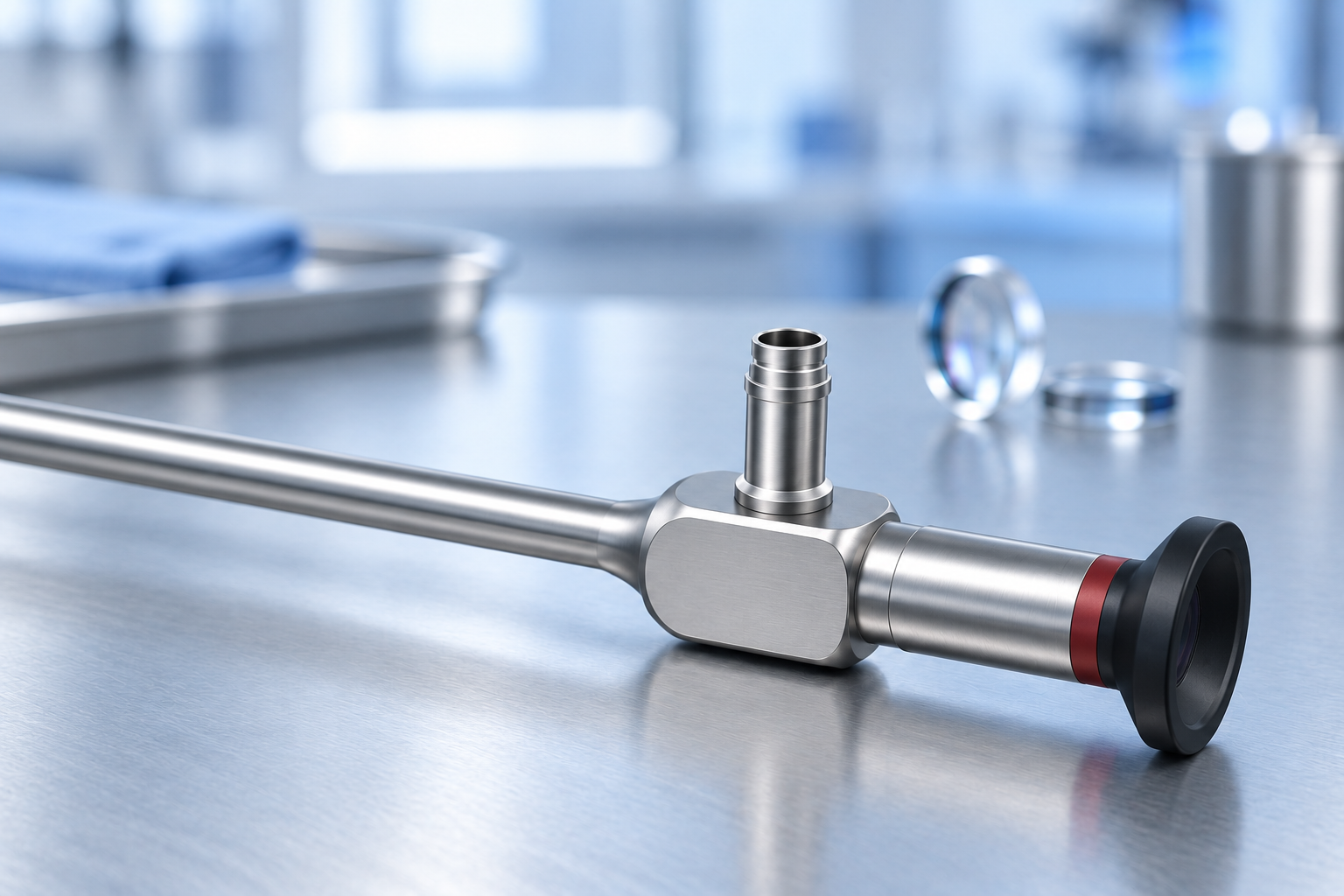
An attractive endoscopic image can make a strong first impression. But it does not answer the questions that matter most in a purchasing decision.
Which model produced the image? What camera and illumination system were connected? Under what conditions was the image captured? Do the quotation, sample and supporting documents all describe the same product configuration?
For distributors, importers, endoscopy system manufacturers and OEM buyers, useful supplier evaluation begins with traceable, comparable and configuration-specific evidence. That evidence helps a buyer decide what can be compared now, what requires further evaluation and what belongs in a later commercial discussion.
This checklist is a purchasing aid. It is not a certification assessment, a regulatory determination or a clinical selection guide. Its purpose is to turn an initial supplier conversation into a documented evaluation with clear next steps.
A Quick Buyer Checklist
On a narrow screen, scroll the table horizontally to read both columns.
| Buyer question | Evidence to request |
|---|---|
| What exactly am I buying? | Exact model, configuration, accessories and supply scope |
| Are the specifications clearly defined? | Diameter, working length, direction of view, field of view and interfaces |
| Does the optical evidence apply to this model? | Test report, specimen identification, test configuration and method |
| Can the evaluated configuration be supplied consistently? | Revision control, change notification and release documentation |
| Are the documents traceable to the proposed product? | Document title, revision, issuer, date and applicable model |
| How is the product reprocessed? | Applicable instructions for use (IFU) and model-specific reprocessing evidence |
| Has white-light, fluorescence or system matching actually been evaluated? | Configuration-specific evidence |
| What is still unresolved? | Documented open-item list with clear next actions |
If these basic questions cannot yet be answered, detailed price negotiation may be premature. Use the table to establish the scope of the comparison before deciding which supplier needs a closer technical review.
1. Define Exactly What Is Being Supplied
Start with a model-specific configuration list. A rigid optical scope, a camera system and a complete endoscopy tower are different purchasing objects. A product-family name alone does not establish what an offer includes.
Record the product family, exact model and document revision. For the scope, capture insertion diameter, working length and direction of view, with units. Record field of view where documented, separately from direction of view. Include the eyepiece, camera coupling and illumination connection, as well as supplied accessories and items that must be sourced separately.
Product condition also belongs in the supply scope: new, refurbished or another clearly described condition. The quotation, sample and technical documents should all be traceable to the same configuration.
Keep unresolved fields marked as unknown. A similar-looking model, another product in the same family or another brand’s specification is not a reliable substitute. For example, a brochure describing a product family may be useful background while still leaving the proposed model’s working length unresolved. Record that gap rather than silently completing the specification.
2. Do Not Ask Only “What Is the Resolution?” — Ask What Was Actually Measured
Distinguish the rigid optical scope from the complete imaging chain. A practical review covers the rigid optical scope → coupling optics → camera / sensor → processing, together with illumination and display. This is a checklist of contributors to the result, not a serial light-path diagram: illumination supplies the scene, while the display presents the processed image.
A 3840 × 2160 output does not automatically establish the optical resolution of the rigid scope. The output format and the scope’s ability to transfer spatial detail describe different things.
A useful report identifies the model and specimen, camera, working distance, controlled settings and tested field positions. It states whether the result concerns the scope alone or a complete system. Centre-to-edge performance deserves attention alongside centre resolution; a strong central image is only part of the comparison.
Our guide to evaluating optical performance develops these engineering questions. ISO 8600-5:2020 provides a method for determining optical resolution within its stated scope. A reference to the standard is not evidence of conformity; the relevant report and test configuration still need review. 1
3. A Good Sample Is Not the Same as Consistent Supply
A sample evaluation concerns a particular specimen and configuration. Repeat purchasing adds another question: how will the evaluated configuration be identified and maintained across later deliveries?
Review model and revision identification, change notification, release records, batch or serial traceability, and document revision control. Establish how the supplier connects an evaluation sample to the intended production configuration. Where a sample differs from the proposed supply, make the difference and its evaluation consequences explicit.
Component compliance with agreed specifications is necessary, but it is not proof of assembled-scope compliance with the finished-instrument requirements. Centring, spacing, mechanical references, relay-optics alignment and cumulative tolerances affect the completed optical assembly. Our article on precision lens manufacturing explains the distinction between component inspection and assembled-instrument evaluation.
The practical output is a traceable link between the sample reviewed, the configuration agreed and the documentation available with delivery. These are matters to establish with each supplier, rather than capabilities to assume from a convincing demonstration.
4. Make Every Document Traceable to the Product Under Evaluation
A folder full of PDFs is not the same as controlled documentation. Build a document list around the product being considered, then record five identifiers for each item: title, issuer, revision, date and applicable product.
Keep commercial literature, engineering reports, conceptual illustrations, and certificates or regulatory documents separately labelled. Each serves a different purpose. A concept illustration can explain an idea without being a measured result. A report for another model may provide context, but it does not automatically support the current model.
When a certificate or authorization is presented, identify the legal entity, products, activities and market it covers, then refer applicability to the appropriate qualified reviewer. This keeps document collection separate from regulatory acceptance.
For a purchasing discussion, the useful question is whether the received document resolves the stated issue for the proposed configuration. If the answer depends on a missing revision or product identifier, retain that dependency in the open-item list.
5. Review Reprocessing and Sterilization Information for the Specific Model
Request the applicable IFU and supporting information for the proposed reusable device. Reprocessing review needs to remain device-specific, model-specific and tied to the evidence provided. FDA’s general explanation also identifies the need for device-specific reprocessing regimens. 2
Where a supplier uses terms such as repeated steam sterilization, autoclave sterilization or “500-cycle autoclave durability,” clarify what the statement represents: a design target, an internal engineering result, formal validation, or an approved product claim. These descriptions carry different meanings. A cycle count alone does not establish validation, and the example here is not a performance statement for an Opentic model.
Keep the stated conditions, model applicability and limitations attached to the evidence. The IFU, durability description and supporting report should be reviewed together for consistency. This section is a document-review aid, not a reprocessing procedure. Temperature, pressure, holding time and practical processing instructions must come from the applicable device instructions and responsible professionals, not from a general supplier checklist.
6. Keep White-Light, Fluorescence and System Compatibility Separate
Mechanical compatibility, optical compatibility and validated fluorescence-system performance are separate review questions. A physical connection may fit while the optical configuration still needs evaluation. Optical compatibility, in turn, does not automatically establish validated fluorescence-system performance.
For a proposed ICG / NIR configuration, review the relevant parts together: excitation illumination, visible and NIR scope transmission, coupling, spectral separation, camera or detector, visible-to-NIR focus behaviour and processing. A description of one component cannot stand in for evidence about the complete combination.
Record the intended camera, light source, coupler and imaging platform, then identify the exact combination covered by any demonstration or report. Separate evidence for white-light operation from evidence for fluorescence operation. Where the evaluation covers one combination, retain that boundary instead of extending it to all systems carrying a similar label.
The ICG fluorescence imaging guide explains the engineering context. For supplier selection, the immediate goal is a clear statement of what has been evaluated, under which configuration, and what remains open for system matching.
7. Give an OEM Discussion Usable Inputs
An OEM conversation is more productive when the buyer brings a defined problem. Prepare the product type, system architecture, insertion diameter, working length, direction of view, mechanical interfaces and intended camera system. Specify white-light or fluorescence mode, the target market and evaluation requirements.
Mark each requirement as fixed or open for discussion. A fixed interface and an exploratory working-length preference call for different responses. This distinction helps a supplier identify an existing documented option or explain where feasibility work would be needed.
Keep existing documented options separate from requests requiring feasibility work. Record the next evidence needed, who will supply it and which decision depends on it. A preliminary discussion is not confirmation of customization capability; a sample image is not validated performance.
Distributors can use the same approach at a simpler level: identify the family and configuration they want to evaluate, the intended system context and the documentation needed for a supply discussion.
8. Technical Approval Is Only Part of Supplier Selection
Once the technical configuration is sufficiently clear, review the proposed supply arrangement. Relevant topics include lead time, minimum order quantities, continuity of supply, change notification, packaging and labelling, after-sales support, warranty or replacement arrangements, documentation support and long-term product availability.
These items vary by supplier, market and agreement. Confirm which terms apply to the proposed model and order rather than treating a general sales statement as a commitment.
It can help to keep the technical open-item list alongside the commercial one. A delivery discussion may depend on a configuration still being evaluated; a documentation request may affect what the parties need to agree before ordering.
A good sample is only the beginning. A supply relationship depends on the ability to deliver the required configuration consistently over time. Technical acceptance and a workable supply agreement both deserve an explicit decision.
9. Use an Evidence Checklist Before Using a Score
There is no universal 100-point supplier score. Use the following priorities to organize the review, not to calculate an automatic approval. The headings guide the sequence of inquiry; they do not make safety-critical or applicable regulatory requirements optional.
MUST HAVE
Establish clear product identity, the exact model and supplied configuration, critical dimensions, intended imaging mode, and core documents traceable to the product. These basics define what is being evaluated. Unresolved identity or configuration questions make later comparisons difficult to interpret.
SHOULD VERIFY
Review optical-performance evidence, centre-to-edge behaviour, manufacturing consistency, reprocessing evidence, documentation traceability and system-matching evidence. Identify the report or record that addresses each issue and the configuration to which it applies. Determine which gaps must be resolved before the intended purchasing decision.
PROJECT-SPECIFIC
Add OEM customization, platform-specific integration, market-specific documents, dedicated performance requirements, packaging or labelling, and commercial conditions as the project requires. This category reflects variation between projects, not reduced importance.
For every open item, record the question, evidence received, applicable model, remaining gap and responsible next step. A missing document is not a conclusion. Commercial interest, technical acceptance, regulatory assessment and purchasing approval remain separate.
10. What to Prepare Before Contacting a Supplier
A useful first inquiry can be organized into five categories:
- Product type: laparoscope, thoracoscope or another rigid optical scope. Identify the purchasing object clearly.
- Key configuration: insertion diameter, working length, direction of view and interface requirements. Mark unknowns instead of borrowing values from a different model.
- Imaging mode: white-light or ICG / NIR fluorescence. State whether one mode or both are part of the evaluation.
- Target system: camera, light source, coupling and any existing imaging platform. Include model identifiers when available.
- Project context: distributor sourcing, an OEM project or system matching, together with the target market and documentation needs.
Clearer inputs help determine whether an existing model may fit, whether system matching is needed, whether the request involves OEM development, and what evidence is required next. A short inquiry that identifies these boundaries is more actionable than a request for a general catalogue and the lowest price alone.
Starting a Product Discussion with Opentic
The current product families provide a starting point:
- White-light Laparoscope
- ICG Fluorescence Laparoscope
- White-light Thoracoscope
- ICG Fluorescence Thoracoscope
For system matching, customization or an OEM discussion, visit OEM / ODM. If the product family and proposed configuration are already known, use Contact to describe the information needed for evaluation.
Our preferred starting point is not a sales conclusion. It is a clearly defined discussion of the product, configuration, system boundary and questions that still need evidence.
References
- ISO 8600-5:2020, Optics and photonics — Medical endoscopes and endotherapy devices — Part 5: Determination of optical resolution of rigid endoscopes with optics. Official ISO record. Reviewed 9 October 2026. This article references the published title, scope and status information available from ISO. Formal testing, conformity assessment or regulatory work should use the applicable licensed standard and validated test methods.
- U.S. Food and Drug Administration, How are Reusable Medical Devices Reprocessed? Official explanation. Reviewed 9 October 2026. Referenced for general context that reusable medical devices require device-specific reprocessing information and instructions. It is not used here as market-specific regulatory guidance or as an Opentic product reprocessing instruction.